
Ditch / Field notes
Start Free on One Jobsite: Evidence Grade Jobsite Photo Management
Start Free on One Jobsite: Evidence Grade Jobsite Photo Management
The right approach is a purpose-built jobsite photo management system that enforces timestamps, GPS, and tagging on every shot, then syncs the whole record to the office automatically. Ditch is built around exactly this workflow, using AI to tag equipment, location, and work type without anyone typing a caption. That combination gets you three things a shared camera roll never will: a searchable record, evidence-grade metadata, and a crew that stays in sync without extra admin.
TL;DR:
- Automated capture of timestamps, GPS, and work tags at the moment of photo take is essential for creating defensible and searchable jobsite records.
- Organization should rely on a consistent folder hierarchy, tagging, and spatial pinning rather than just storage capacity or manual sorting.
- Photos paired with embedded metadata and detailed notes are crucial for evidence that holds up during disputes or inspections.
- Trial plans that charge per jobsite rather than per user allow full team access without increasing costs as your crew grows.
- Offline capture and automatic sync enable reliable use on remote sites, ensuring all images and metadata are preserved and uploaded once connectivity returns.
Table of Contents
- What Features Should Jobsite Photo Management Software Have?
- How Do You Capture Photos That Hold Up Later?
- How Do You Organize and Tag Jobsite Photos for Fast Retrieval?
- How Do You Turn Jobsite Photos Into Reports Stakeholders Actually Use?
- Why Does Offline Capture and Sync Matter on Remote Sites?
- What Should You Check Before Choosing a Jobsite Photo Tool?
- How Ditch Applies This in Practice
- Why Most Teams Get Jobsite Photo Management Backwards
- Start With a Free Jobsite and See the Difference
- Where to Learn More
- Sources
- FAQ
What Features Should Jobsite Photo Management Software Have?
A camera roll shows you a photo. It doesn’t tell you where it was taken, who took it, or what it proves. That gap is exactly what jobsite photo management software is built to close, and the best tools do it with a specific set of capabilities rather than a vague promise of “organization.”
Look for these core functions before you commit to any platform:
- Enforced capture metadata: timestamp, GPS coordinates, and cardinal direction locked into every photo at the moment it’s shot, not added later.
- Organizational primitives: projects, albums, tags, and the ability to pin a photo directly to a map or plan view.
- Search and retrieval: metadata search by date, location, or tag, plus AI-assisted visual search when you don’t remember the exact filename.
- Workflow links: the ability to attach a photo directly to a daily log, an RFI, or a field observation instead of storing it in isolation.
- Security controls: permission settings and access logs so you know who saw or exported what, and when.
Miss any one of these and you’re back to scrolling through a camera roll during a dispute, which is precisely the moment you can least afford it.
How Do You Capture Photos That Hold Up Later?
A photo without context is just a picture. A photo with the right context becomes evidence. The difference comes down to what you capture and how consistently you capture it, not the quality of your phone’s camera.
- Frame the four basics in every shot: who’s on site, what’s happening, where exactly it’s happening, and why it matters for the project record.
- Pin the metadata to the image itself, not just the device. Visible, embedded timestamps and GPS hold up better than relying on phone EXIF data alone, which can be stripped or altered when files move between apps.
- Use 360° panoramas for full-room or full-site context, and include a visible scale reference (a tape measure, a known object) whenever dimension matters.
- Shoot on a cadence: before, during, and after each milestone, in the same order each time, so comparisons are easy later.
- Pair each photo with a short note. A 3-line job notes template covering the issue, the action, and the outcome removes most of the ambiguity that turns a photo into a “what am I looking at?” moment months later.
Pro Tip: In low light or dusty conditions, shoot one wide establishing shot before you get close. It anchors the detail shots to a location even when the closeups are hard to place on their own.
How Do You Organize and Tag Jobsite Photos for Fast Retrieval?
The fastest way to lose an hour is to search a shared drive for “that photo of the electrical panel from last month.” A consistent structure prevents that entirely, and it doesn’t need to be complicated.
Most teams do well with a simple hierarchy: project, then phase, then area, then date. On top of that, a tagging layer by trade, equipment, issue type, or work type lets you cut across the folder structure when you need to, say, pull every photo of a specific piece of equipment across three different jobsites.
- Freeform hashtags are fast to apply but drift over time as different people invent their own versions of the same tag.
- Structured fields (a dropdown for “trade” or “equipment”) take a few seconds longer per photo but stay consistent across a whole crew.
- Map or plan pinning adds a spatial layer that a folder tree can’t. When an inspector asks “what does the northeast corner look like,” you point at the plan instead of guessing which album it’s in.
- Combine tags, dates, and text in a single search when the tool supports it, and lean on AI-assisted visual search for anything that predates good tagging habits.
- Export to PDF for a polished, shareable record; keep raw images archived separately for anything that might need to go back to original resolution.
How Do You Turn Jobsite Photos Into Reports Stakeholders Actually Use?
A photo dump attached to an email gets ignored. A photo with context, tied to a location and an outcome, gets read. The format you choose should match who’s receiving it.
- Live project links work best for ongoing collaboration, since owners and inspectors always see the current state without you re-sending files.
- Static PDFs suit a formal milestone report or a closeout package where you want a locked, dated snapshot.
- ZIP or KMZ exports matter for geospatial or audit reviews, where someone needs to load your data into their own mapping or compliance software.
- Always include captions, pinned-plan references, and any attached observations. A photo without a caption forces the reader to guess at context you already had in the field.
- Guest access with view-only permissions lets an owner or inspector see exactly what they need without touching the rest of your project archive.
Why Does Offline Capture and Sync Matter on Remote Sites?
Cell coverage on a rural site or a basement pour is unreliable at best. Photo management software built for the field needs to work when the signal doesn’t, and it needs to catch up automatically once it does.
- Offline capture should save photos locally with full metadata intact, then queue them for upload the moment a connection returns, no manual re-sending required.
- Large image and 360° files eat bandwidth fast, so check how a platform compresses or batches uploads without stripping GPS or timestamp data.
- Integrations with your project management system, cloud storage, or daily log tool save you from re-entering the same information twice.
- Access logs and retention settings matter for OSHA recordkeeping purposes, where a defensible, timestamped record can be the deciding factor in an incident review.
What Should You Check Before Choosing a Jobsite Photo Tool?
Not every “photo app” is built for construction documentation, and the gap usually shows up at the worst possible time, mid-dispute, mid-inspection, or mid-audit. Run through this before you sign a contract:
- Match features to your actual risk: if you deal with inspections or disputes often, evidence metadata and access logs matter more than fancy filters.
- Ask in the demo: “Can I see the raw timestamp and GPS data behind this photo?” and “What formats can I export, and does the metadata travel with the export?”
- Understand the cost model: per-jobsite pricing scales differently than per-user pricing, and per-user costs can balloon fast as crews grow. Watch for hidden storage charges that kick in once you pass a free tier.
- Walk away from red flags: apps that rely on manual camera roll uploads, offer no meaningful permission controls, or lock your data into a format you can’t export.
A tool that fails any one of these checks will cost you time exactly when you can least spare it.
How Ditch Applies This in Practice
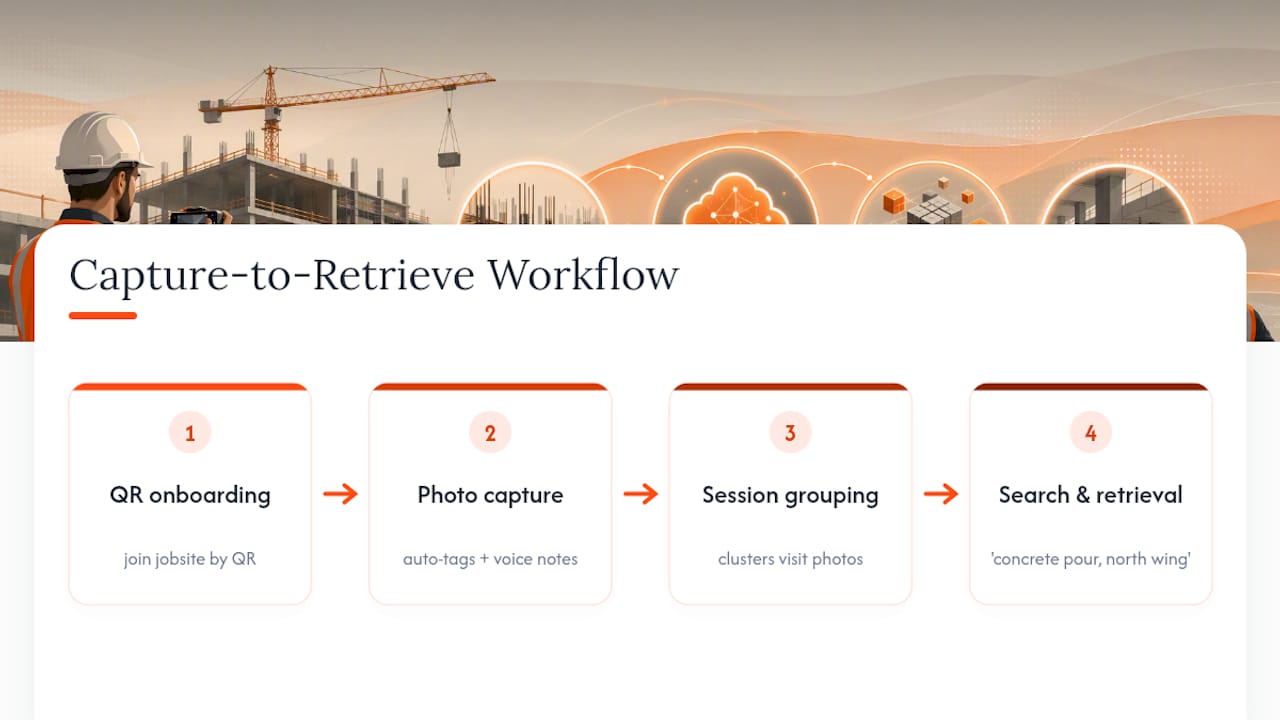
Ditch tags every photo automatically with equipment, GPS, work type, and time, so nobody on your crew has to stop and type metadata by hand. Pricing runs per jobsite rather than per user, which means your whole team, including subs, can access the record without triggering incremental seat fees.
The practical payoff shows up at retrieval. Instead of scrolling a camera roll, you search “concrete pour, north wing” and get exact matches. Onboarding is built to match that speed: crew members join a jobsite by scanning a QR code, no account setup required, and voice notes let a foreman add context without typing on a job phone. Session grouping automatically clusters photos taken in the same visit, so a full site walk becomes one organized entry instead of forty scattered files.
Why Most Teams Get Jobsite Photo Management Backwards
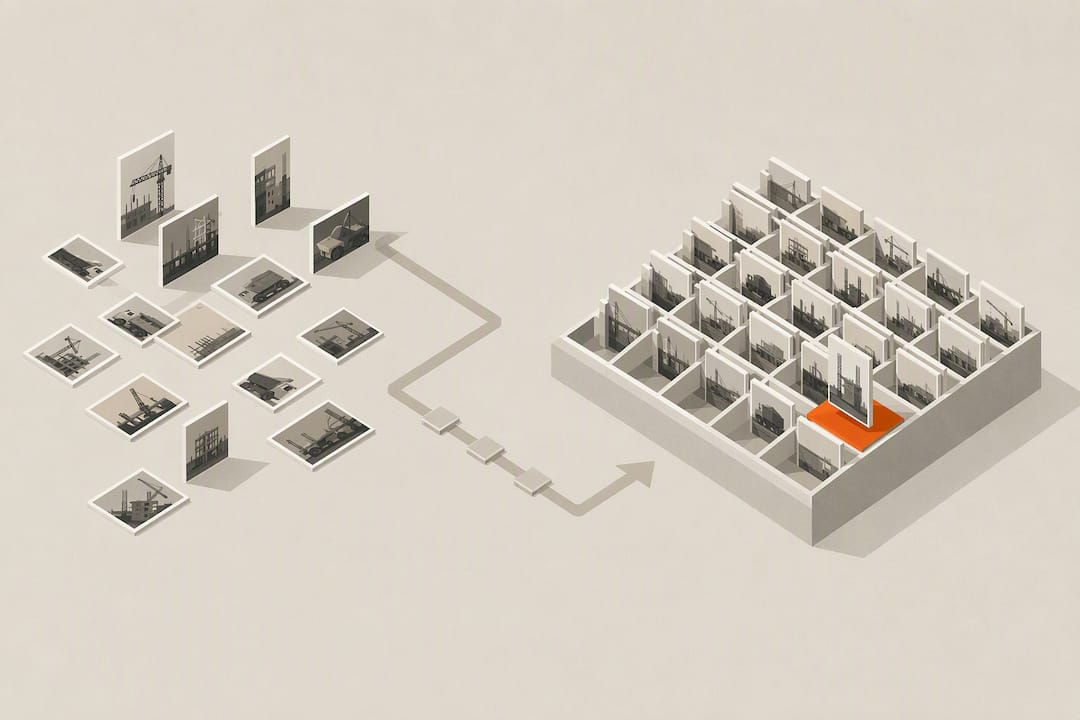
Most teams treat photo management as a storage problem. Buy more cloud space, create more folders, and hope someone remembers where they put things. That’s backwards. Storage was never the constraint. Retrieval was.
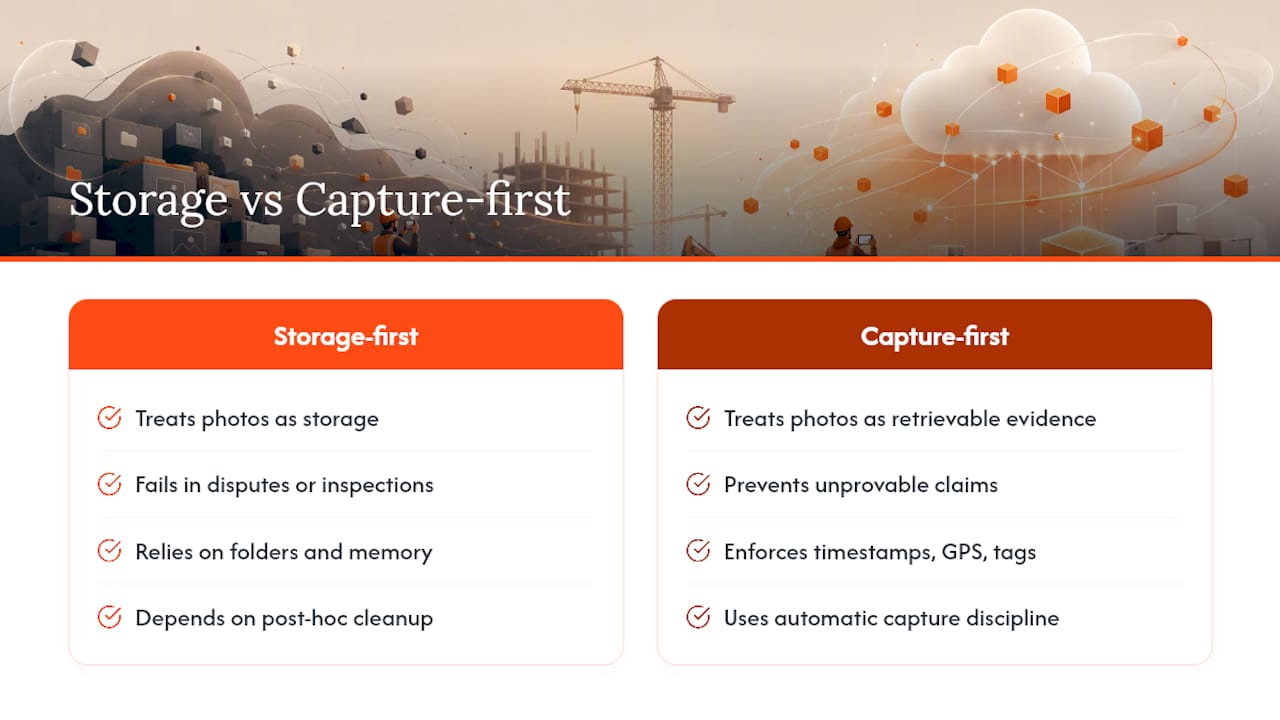
The teams that actually benefit from a jobsite documentation system are the ones who get burned once, an insurance dispute where nobody could produce a timestamped photo, or an inspection where the “before” shots were buried three folders deep, and decide never to repeat it. The conventional advice tells you to “stay organized.” That’s true but useless. Organization without enforced metadata just means you have a tidier pile of photos that still can’t prove when or where they were taken.
Here’s what actually matters: capture discipline at the moment the photo is taken, not cleanup after the fact. If timestamps, GPS, and tags are enforced automatically instead of left to memory, your record stays defensible without anyone having to think about it. That’s the entire argument for jobsite-priced, AI-tagged systems over free camera apps. The cost of the software is trivial next to the cost of one unprovable claim.
— Will
Start With a Free Jobsite and See the Difference
Some jobsite photo management tools charge by the jobsite rather than per user, which can allow whole crews and subcontractors to capture and search photos without seat limits. That’s a real shift from tools that charge per user and punish you for growing your team.
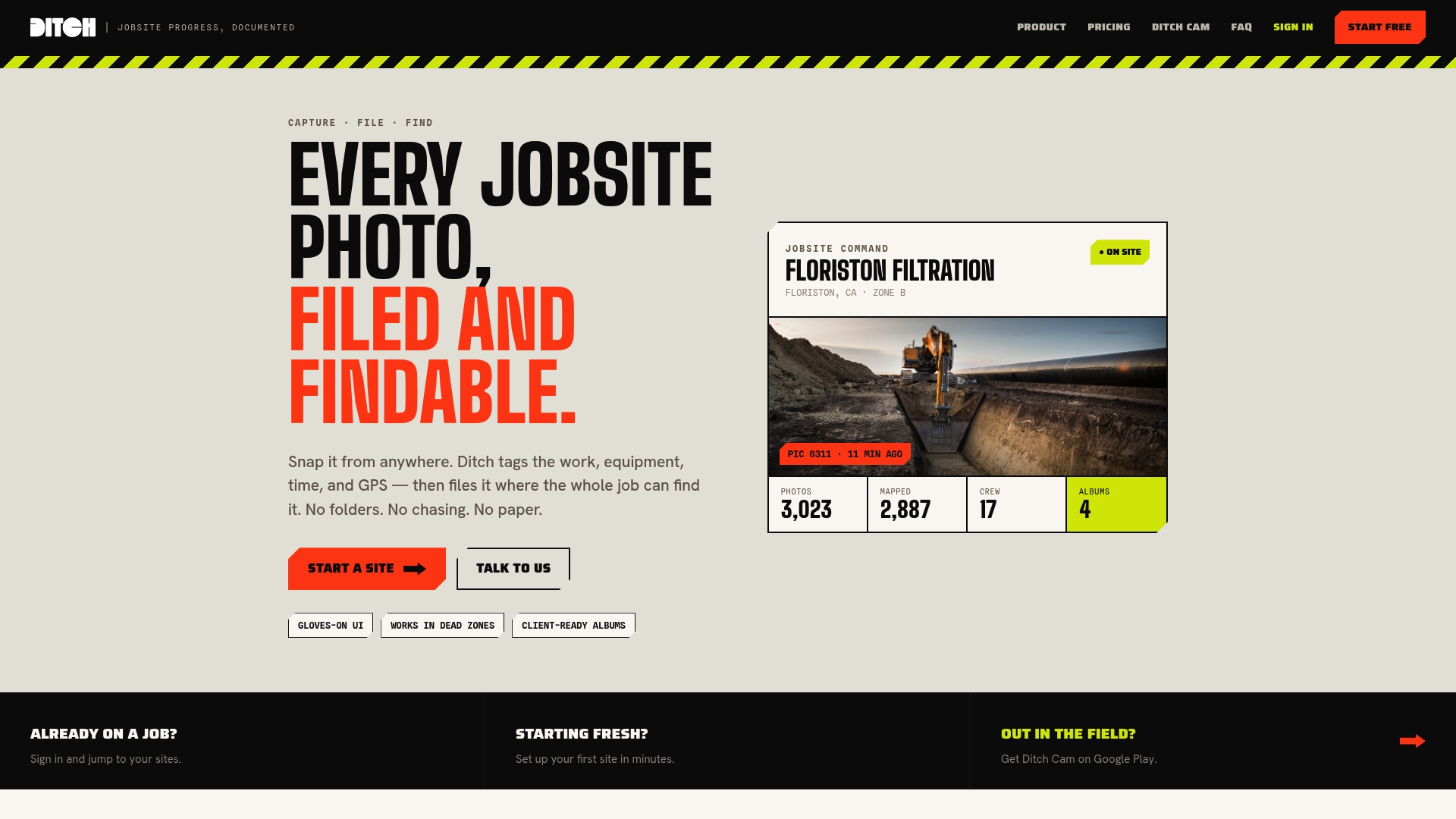
Getting started takes almost no setup. Sign up for the Free plan and run it on a single jobsite to see how automatic tagging and search actually feel in the field. For managing multiple sites, paid plans often scale with your jobsite count rather than payroll, so a growing crew does not necessarily mean a growing bill. Bring one real project’s worth of recent photos to your first session and search for something specific, an equipment type, a work area, a date range. That’s the fastest way to see whether the retrieval speed matches what your team actually needs. Check current plan details on the Ditch pricing page or start directly from the Ditch homepage.
Where to Learn More
- OSHA recordkeeping guidance for what qualifies as defensible documentation.
- 3-line job notes template to pair with your photo records.
- Handover documentation guidance for structuring closeout packages.
Sources
- Recordkeeping | Occupational Safety and Health Administration (OSHA)
- 3 Line Job Notes Template for Field Technicians, Plus 3 Photo Rule
FAQ
What Is the Best App for Managing Jobsite Photos?
The best choice is a purpose-built platform that enforces timestamps, GPS, and tagging automatically rather than a general camera roll or cloud folder. Ditch does this with automatic tagging and jobsite-based pricing, which suits teams managing multiple sites without wanting to pay per user.
What Is the 20-60-20 Rule in Photography?
The 20-60-20 rule is a composition guideline used mostly in portrait and event photography, describing a balance of wide, medium, and close-up shots to create visual interest, but it is not directly applicable to jobsite documentation where consistent coverage matters more than visual variety. It doesn’t apply to jobsite documentation, where the priority is consistent coverage of a location over time rather than visual variety.
How Much Does Jobsite Photo Software Typically Cost?
Costs vary widely by pricing model. Per-jobsite pricing tends to scale better for growing crews since it doesn’t charge per additional worker; Ditch’s plans start with a free tier for a single jobsite, with paid tiers priced by jobsite count rather than headcount.
How Do You Organize Years of Jobsite Photos?
Start with a consistent folder hierarchy of project, phase, area, and date, then layer tags for trade, equipment, or issue type on top. For a large existing backlog, prioritize tagging the photos tied to active disputes or ongoing warranty periods first, then work backward chronologically.
Why Do Timestamps and GPS Matter So Much for Jobsite Photos?
Verifiable time and location data turn a photo into evidence rather than just a picture, which matters directly for OSHA recordkeeping and incident documentation. Embedded, visible metadata holds up better than relying on a device’s hidden EXIF data, which can be stripped when files move between apps.